Reading time, Enthusiasts, and nothing dreary and dangerous like politics: our subjects include rococo homes, baroque bands, and how awesome I am.
We begin with what began as an adjunct to Lost Live Dead, but has since become its own river of well-sourced Rock Nerdery: Hooterollin has the all the family secrets behind Me And My Uncle. John Phillips, from the Mamas and the Papas and also incest, wrote it–maybe–during a tequila-fueled public blackout, and then Judy Collins got involved; it’s a long and interesting story, so go read it.
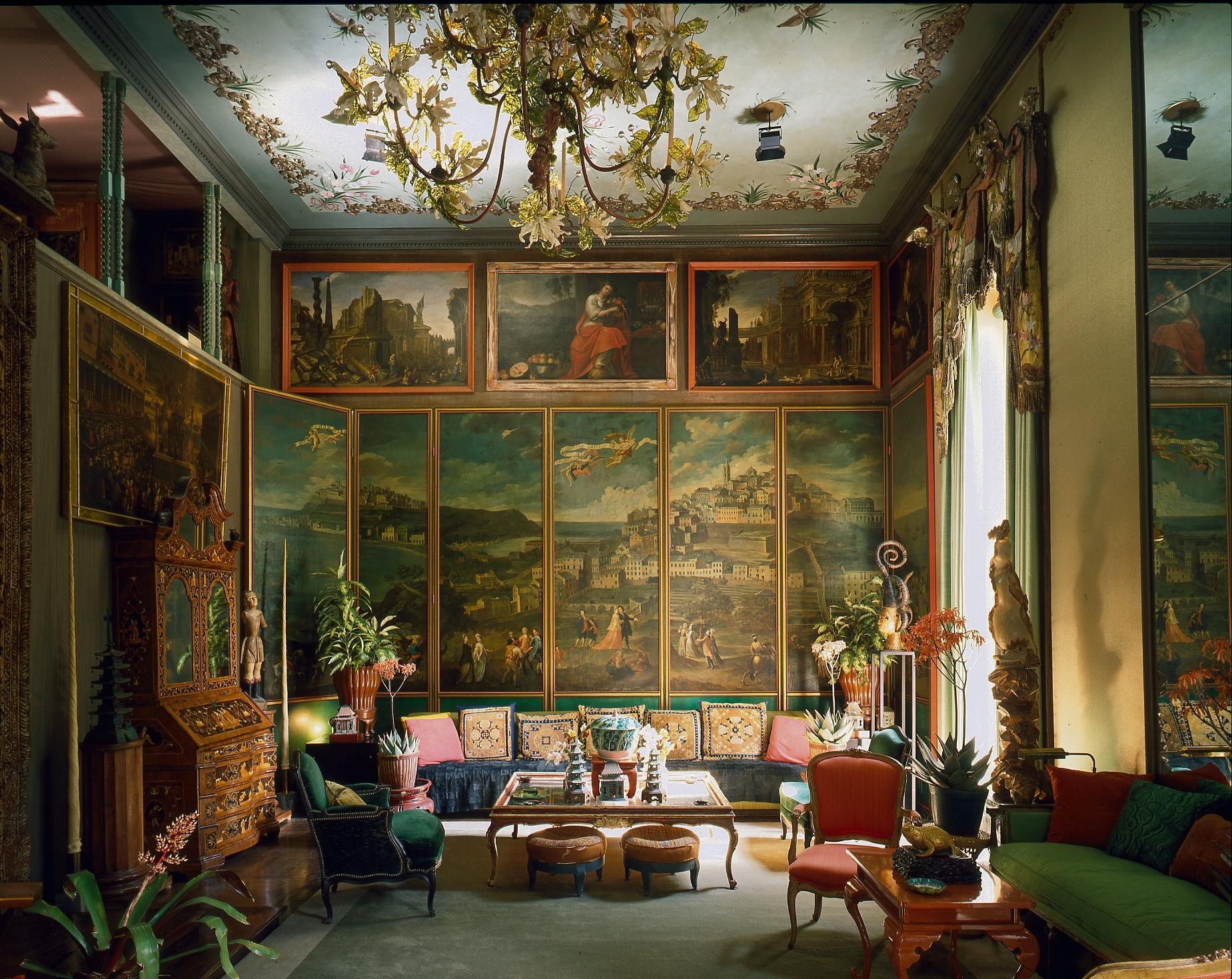
Or you could take a look at Tony Duquette’s work. He was a designer from Los Angeles who worked on movies and for the theater, and made restaurants and hotels look swanky; when he went home, he preferred a restrained decor.
Nah, just kidding: he was an insane maximalist who put all the furniture and all the art in every room always. This is low-key compared to what he thought a bathroom was supposed to look like.
One of my very first posts was about P-Funk, and their relation to the Dead (none at all except what I make up), and I hate to quote myself but no one else does: P-Funk and the Dead are different answers to the same question – What if we gave these [REDACTED] kids way too much acid and amplification? Put “working-class black kids from Jersey raised on soul and church music” in the brackets, and you get P-Funk. Substitute “middle-class white kids from Marin raised on jazz, bluegrass, and classical” and you get the Dead.
The Dead formed in a music store; The Parliaments (the group that would mutate into P-Funk) formed in a barber shop. Context is everything.
Otherwise: four-hour shows with twenty-minute songs blending into one another; nineteen people on stage; money stolen constantly.
Let’s see if I can do the history of P-Funk in one sentence: George Clinton and some guys, two of whom were named Fuzzy and Grady, got a doo-wop group together, but found little success at Motown and got their name stolen via some legal bullshittery, which George got around by naming the backup touring band for the vocalists Funkadelic–they were funky and psychedelic, y’see–and releasing a bunch of raw and acid-soaked records that sounded like Black Sabbath (with an emphasis on the black part); after winning the name Parliament back, George started putting out more soul and vocal-based stuff under that name (but only sort of: there’s guitars on Parliament records and ballads and harmonies on Funkadelic albums), and then Bootsy Collins showed up, and then George Clinton discovered crack and lawyers.
Ta-da.
P-Funk is better thought of as “P-Funk”: besides the two main groups–which both had rather fluid lineups, anyway–there was Bootsy’s Rubber Band, and the Brides of Funkenstein, and The Horny Horns, and solo albums aplenty: it was all the same shit. It was the good shit: hell, it was the bomb, but everything had the same sound; it’s tough not to when everything is on The One.
And that’s where the philosophies of P-Funk and the Dead cannot be reconciled. “Everything is on The One” and “The One is wherever you think it is” can’t work together; it’s like quantum mechanics vs. classical physics: you have to choose one or another. (Although an argument could be made that it deliberately avoiding the downbeat, it’s emphasized just as much as playing it.)
Another point of diametric opposition is the singing: Parliament started as a doo-wop group, and most of the instrumentalists could sing their asses off, and the Brides were always around; there were easily a dozen people on a P-Funk stage who were the best singer you’ve ever heard. There were elaborate harmony lines that got passed around and call-and-responsed and counterpointed, and the vocals would slide up against the horn section nice and smooth; it was the bomb. In the Dead, Phil sang the high harmonies while the other two forgot the words. Later on, Mrs. Donna Jean would sing the high harmonies while the other two forgot the words. (I could write this sentence two more times.)
P-Funk only had about ten good years, and there won’t be a stadium-sized reunion for the 50th; the Mothership was left to rot in a scrap yard in Maryland. Nothings gonna bring them back.
Bernie’s not gone, yet; give him and his friends a listen tonight.
This is a deeply silly, profoundly slight song; it is not live: those fans are recorded and mixed in; the melody reached heights that George Clinton can barely even see, let alone sing. It’s nine levels beneath Deep Cut.
But, God, I love this dumb song. Bernie Worrell on the acoustic piano.
Bill Graham used to introduce the band by saying, “Not only are they THE BEST at what they do, they’re also THE ONLY ONES who do what they do: Ladies and Gentlemen, the Grateful Dead.” Which was elegant and eloquent but not quite true.
Miles Davis’ 70’s bands were doing the same thing as the Dead, except without any first set niceties. Miles and the Dead shared a San Francisco stage right after Miles’ masterpiece (that should probably read “right after one of the many, many masterpieces he produced), Bitches Brew came out. Miles had been working with an electric bass player since about the moment he decided, “I must destroy this concept of the song. There is no Song! Songs were invented by white devils! I’m just going to find a bunch of musicians and freak out for 60 minutes at a time.”
Miles, as usual, is not telling you the whole story. That “bunch of musicians” has to include Jack DeJohnette and Keith Jarrett and Herbie Hancock and Wayne Shorter or the entire plan falls apart. Plus, Miles’ bands are sometimes mired in the jazz tradition of laying back while someone solos, instead of the full-band improvisational composition that the Dead do. You know what I’m talking about: the stuff that’s worth sitting through all the nonsense and noodling for. When the boys flow from one song through another and back and you never realize what they’ve done until you’re already amazed; it’s a musical magical trick when they do it right.
Miles was sometimes accused of cynicism: that his ’70’s electric period was not purely a musical journey, just an excuse to go from his usual clubs to playing the much larger (and therefore more lucrative) halls and theaters that the bands on the rock circuit did. This might have been one reason, sure, but you can never discount the possibility that Miles just didn’t want to rehearse anymore, as it took time away from driving a Lamborghini packed with white women through city streets at 100 mph, then accusing the officer that pulled him over of being–dependent on the situation–“a racist cracker-ass cracker,” or “an Uncle Tom motherfucker.” Miles was a real piece of work.
There was another band criss-crossing the country in the 1970’s trying to Reconnect with The Holy through playing really loud and long: P-Funk. Whatever the hell George Clinton was calling whichever group of guys were in the room when they made the record: Parliament, Funkadelic, the P-Funk All-Stars, Funk-isyahu and the Klezmer Kids, whatever.
P-Funk was the answer to the question, “What if we gave poor black kids in Jersey and middle-class white kids in San Francisco the exact same drugs and massive amplifiers?’
And, of course: the leaders of all three of these groups are dead. I know George Clinton thinks he is still alive, but he died three years ago–trust me on this one.




Recent Comments